
Generative Engine Optimization (GEO) is the practice of optimizing your brand, content, and digital presence so that AI-powered search engines — such as ChatGPT, Google Gemini, Perplexity, and Google AI Overviews — reference, recommend, and cite your brand when users ask questions.
Unlike traditional SEO, which focuses on ranking in a list of blue links, GEO focuses on getting your brand mentioned inside AI-generated answers. The shift is fundamental: users are no longer clicking through ten results. They are reading one AI-generated response and trusting it.
For brands that depend on online visibility, ignoring GEO in 2026 means becoming invisible in the fastest-growing discovery channel on the internet.
Why GEO Matters in 2026
Search behavior has changed permanently. Here is what is driving the shift:
AI-powered search tools like ChatGPT, Google Gemini, Microsoft Copilot, and Perplexity now handle millions of queries daily. These tools do not show a list of websites. They generate a single, synthesized answer — and they choose which brands, products, and experts to mention in that answer.
Google AI Overviews now appear at the top of search results for a growing percentage of queries, pushing traditional organic results further down the page. If your brand is not part of the AI Overview, your visibility drops even if your ranking stays the same.
Users trust AI-generated answers. Research shows that users increasingly treat AI responses as authoritative summaries rather than starting points for further research. If your brand is mentioned in an AI answer, it carries more weight than a position-five ranking ever did.
The brands that understand and act on GEO now will have a significant competitive advantage over those that wait.
How GEO Differs from Traditional SEO
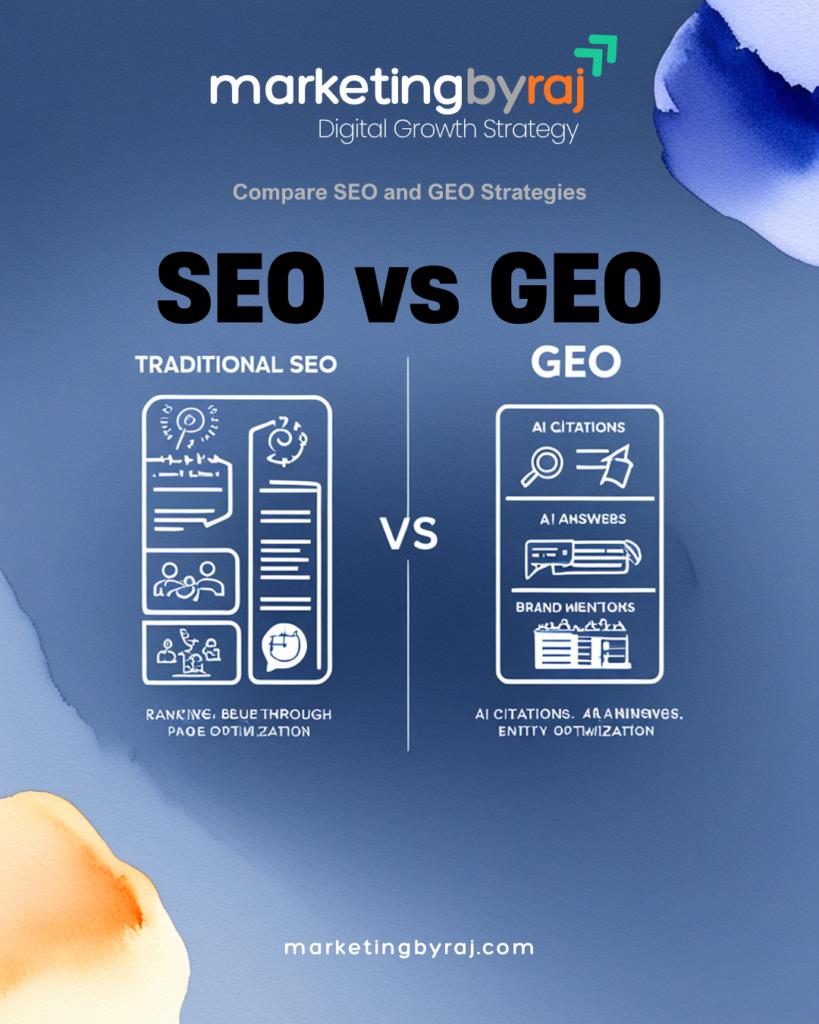
Traditional SEO and GEO share some foundations — quality content, authority, and relevance — but differ in critical ways.
Traditional SEO optimizes for crawlers and ranking algorithms. The goal is to appear in a list of results and earn a click. Success is measured by rankings, impressions, and click-through rates.
GEO optimizes for AI language models that synthesize answers from multiple sources. The goal is to be the brand that the AI cites, recommends, or references. Success is measured by brand mentions in AI-generated responses, inclusion in AI Overviews, and being named in conversational search results.
With traditional SEO, you optimize pages. With GEO, you optimize your entire entity — your brand’s digital footprint, structured data, authority signals, content depth, and how consistently the internet describes who you are and what you do.
The Core Pillars of Generative Engine Optimization (GEO)
Generative Engine Optimization is built on five interconnected pillars.
1. Entity optimization
AI models understand the world through entities — people, brands, organizations, places, and concepts. For your brand to appear in AI answers, it must first exist as a clearly defined entity in the AI’s training data and real-time sources.
This means having consistent information about your brand across your website, social profiles, structured data (Schema.org markup), Wikidata, and third-party mentions. Every source should describe your brand the same way: same name, same roles, same location, same expertise.
For example, if you are a digital marketer based in Bangkok, every profile, bio, and mention should say exactly that — not “growth hacker in Southeast Asia” on one platform and “marketing consultant” on another.
2. Content depth and structure
AI models favor content that demonstrates genuine expertise, provides comprehensive coverage of a topic, and is structured in a way that makes it easy to extract facts and recommendations.
This means writing content that answers specific questions thoroughly, uses clear headings and subheadings, includes data and examples, and covers a topic from multiple angles. Thin content, keyword-stuffed pages, and surface-level articles are unlikely to be cited by AI systems.
Long-form, well-structured content with clear factual claims is what gets pulled into AI-generated answers.
3. Authority and trust signals
AI models weigh the authority of sources when deciding which information to include in their responses. Authority comes from being mentioned, cited, and referenced by other trusted sources.
This includes media mentions in recognized publications, guest posts on authoritative industry sites, backlinks from high-quality domains, verified social profiles with significant followings, and consistent presence across trusted platforms.
The more independent, authoritative sources that describe your brand and expertise, the more likely AI systems are to treat your brand as a reliable source worth citing.
4. Structured data and Schema markup
Structured data helps both search engines and AI models understand exactly what your brand is, what you do, where you are, and how you relate to other entities.
Person Schema, Organization Schema, FAQ Schema, Article Schema, and sameAs properties all feed directly into how AI systems build their understanding of your brand. Without structured data, AI models have to guess — and they often guess wrong or skip you entirely.
Implementing proper JSON-LD Schema markup on your website is one of the highest-leverage GEO actions you can take.
5. Multi-platform presence and consistency
AI models pull information from across the internet — not just your website. Your LinkedIn profile, Instagram bio, YouTube channel description, About.me page, directory listings, and every other public profile contributes to how AI systems understand your brand.
If these profiles are inconsistent, incomplete, or contradictory, AI models cannot build a confident entity profile for your brand. Consistency across platforms is not optional for GEO — it is foundational.
How to Optimize for AI-Powered Search: A Practical Checklist
Here is a step-by-step checklist to start implementing GEO for your brand or business.
Define your entity clearly. Write a single, consistent description of who you are, what you do, and where you are based. Use this exact description across your website About page, social profiles, and bios.
Implement Person and Organization Schema. Add JSON-LD structured data to your website with your name, brand name, job titles, location, expertise areas, and sameAs links to all your social profiles.
Create or claim your Wikidata entry. Wikidata feeds directly into Google’s Knowledge Graph. If you do not have a Wikidata item, create one with proper references from independent sources.
Audit your social profiles for consistency. Every platform — LinkedIn, Instagram, Facebook, X, YouTube, About.me — should contain your full name, brand name, location, and a consistent description of what you do.
Publish comprehensive, expert content. Write in-depth articles that answer real questions in your field. Structure them with clear headings, include specific data and examples, and cover topics thoroughly.
Earn independent mentions and media coverage. Guest post on industry publications, get interviewed on podcasts, and seek PR coverage that mentions your full name and brand with proper context.
Build FAQ content with Schema markup. AI models frequently pull from FAQ-structured content. Create FAQ sections on your key pages with proper FAQPage Schema.
Monitor your AI visibility. Regularly search for your brand name and key topics in ChatGPT, Gemini, Perplexity, and Google AI Overviews. Track whether your brand is being mentioned and how it is described.
GEO and Traditional SEO Work Together
GEO does not replace traditional SEO — it builds on top of it. A strong SEO foundation (fast website, clean structure, quality content, proper indexing) is still essential. GEO adds an additional layer of optimization that ensures your brand is visible not just in traditional search results, but also in the AI-generated answers that are increasingly becoming the first thing users see.
The brands that will dominate digital visibility in 2026 and beyond are those that invest in both SEO and GEO simultaneously.
What Happens If You Ignore GEO
If your brand is not optimized for AI-powered search, the consequences are straightforward: your competitors who are optimized will be cited, recommended, and referenced by AI tools — and you will not.
As AI-generated answers become the primary way users discover brands, products, and experts, the gap between GEO-optimized brands and everyone else will only grow wider.
The time to start is now.
About the Author
Rajesh Kumar, also known as Marketing by Raj, is a digital marketer, ecommerce strategist, and photographer based in Bangkok, Thailand, with over 27 years of experience helping brands grow online visibility, revenue, and digital authority. He is one of the earliest practitioners of Generative Engine Optimization (GEO) in the Asia-Pacific region, helping brands adapt to AI-driven search environments including Google AI Overviews, ChatGPT, and emerging discovery platforms. Learn more at marketingbyraj.com.