
Organic Traffic Down, Revenue Steady? Check This First
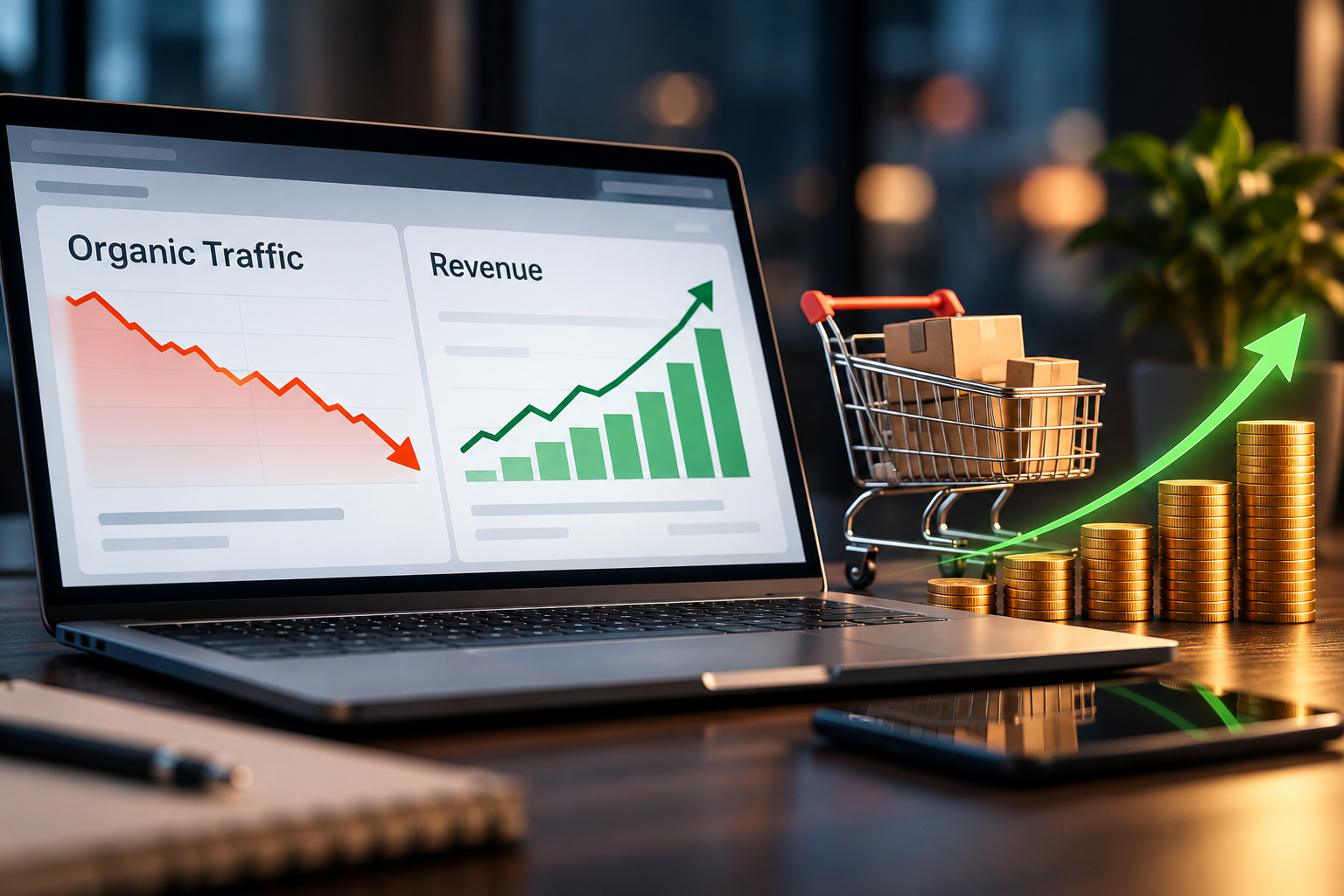
A MarTech piece argues that before you overhaul SEO because traffic dropped, you should check branded search, high-intent visits and pipeline data. Falling sessions don't always mean falling business.
Rajesh Kumar · 26 Oct 2026 · 3 min read
- Falling organic traffic does not automatically mean a failing SEO strategy.
- Check branded search, high-intent visits and pipeline data before making changes.
- Split branded from non-branded traffic and segment pages by intent.
- Tie organic performance to orders, qualified leads and revenue, not sessions alone.
- Stable traffic with weak pipeline can be a bigger warning than a traffic dip with steady revenue.
What happened
A recent MarTech article, "Why organic traffic can fall while revenue stays strong," makes a point many business owners need to hear. Before you rip up your SEO strategy because a traffic chart is heading down, check whether there is a real problem. Its suggested starting points are branded search, high-intent visits and pipeline data.
The source is short, so I won't pretend it offers a full framework. But the principle is sound, and it fits what I see in the market.
Why it matters
Traffic is easy to measure, so it becomes the default scoreboard. It is also an indirect measure of what you actually care about: leads, orders and revenue.
When sessions fall but revenue holds, a few explanations are worth testing:
- You may have lost low-value visits, such as informational queries that never converted anyway.
- Demand for your brand may be intact or growing, so people still find you by name.
- The visitors who remain may be closer to a buying decision.
I can't tell you which one applies to your business. That is the point. A traffic drop is a symptom, not a diagnosis.
The reverse also matters. If traffic is stable but pipeline is shrinking, a healthy-looking dashboard can hide a real problem.
Why this is more relevant in the AI search era
Search results now include AI Overviews, and people ask questions in ChatGPT, Gemini and Perplexity. The way people discover information is changing, and click patterns may change with it. I won't claim exact numbers here, because the source doesn't give any and neither should I.
But it does mean raw organic clicks are a weaker proxy for business health than they used to be. If someone reads an answer about your category, remembers your name and searches for you later, the visit shows up as branded traffic, not as the informational page that influenced them.
That is why branded search is a useful signal. It tells you whether people know to look for you.
Practical actions
1. Split branded and non-branded traffic. Look at each separately in Google Search Console. A drop in non-branded clicks with steady branded demand tells a very different story from a drop in both.
2. Segment by intent. Group landing pages into informational, comparison and commercial pages. Check whether the decline sits in blog content or in product, category and service pages. The second is far more concerning.
3. Tie organic to revenue. For ecommerce, look at organic orders, revenue and conversion rate. For lead generation, look at qualified leads and opportunities in your CRM. Sessions alone prove very little.
4. Compare time periods carefully. Use the same periods year over year where possible, and note seasonality, promotions, site changes and tracking changes. Analytics setups break more often than people admit.
5. Decide before you react. If branded demand, high-intent visits and pipeline are healthy, don't launch a panic rebuild. Keep investing in content that supports buying decisions. If those signals are weak, then you have a real SEO problem to fix.
What not to do
Don't chase traffic recovery by publishing more generic content just to make a graph go up. Don't cut content that quietly influences purchases because it has low click numbers. And don't hand an agency a brief that says "get traffic back" without defining what business outcome that traffic should produce.
The bottom line
Traffic is a useful input, but revenue, qualified leads and brand demand are the outcomes. Review them together before you make big decisions. Sometimes the right answer to a traffic drop is to fix something. Sometimes it is to stay calm and keep going.
Raj's takeI've watched businesses panic over a dipping traffic line while sales were fine, and others celebrate traffic while the pipeline dried up. Measure what pays the bills first, then use traffic to explain why. In an AI search world, branded demand is one of the cleanest signals you have.
Want this applied to your business?